Product Description
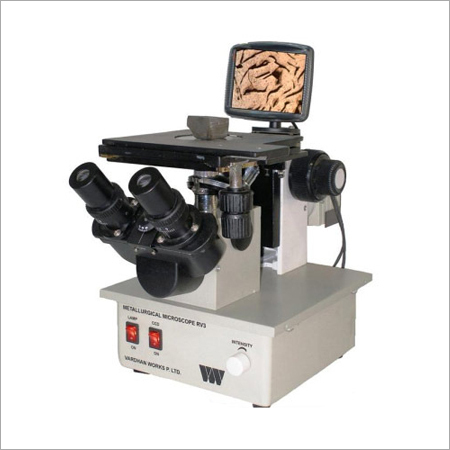
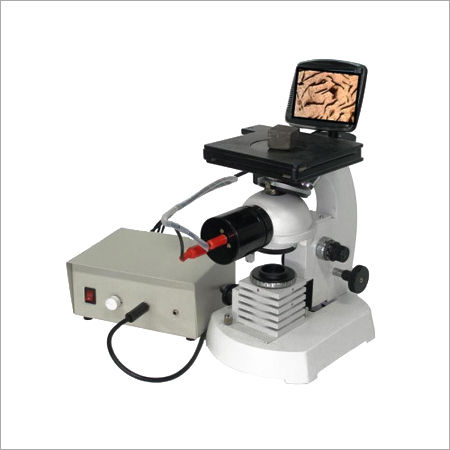
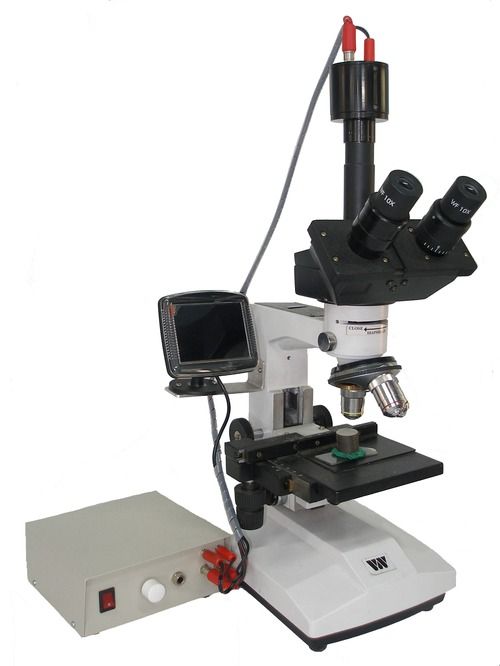
Metallurgical Microscope Type RV3
Salient Features:
- Inverted stage design.
- Built in high resolution Sony CCD camera.
- Magnification 25x to 1000x.
- Can be interfaced with computer for Image analysis.
Versatile Observation and ImagingDesigned with both reflected and transmitted light capabilities, this inverted microscope accommodates petri dishes, culture flasks, and metallurgical samples. The trinocular port easily integrates with digital imaging devices, allowing precise documentation and analysis. Its glass, transparent removable stage plate enhances transmitted light studies, making complex specimen observation more accessible.
Advanced Mechanics and ErgonomicsThe mechanical double-layer stage offers smooth, accurate sample positioning with a generous movement range. Adjustable coaxial coarse (15mm) and fine (0.002mm per division) focusing enable detailed inspections. The inclined view head and rubber eyeguards provide comfortable, extended viewing, reducing user fatigue during long sessions.
Durability and Convenience in the LaboratoryConstructed for robust use, the microscope includes a fitted dust cover, spare halogen lamp, and fuse, ensuring consistent performance and longevity. Its universal 110V/220V AC power supply supports global laboratory environments, while the sleek white frame with black and silver accents delivers both style and resilience.
FAQs of Inverted Metallurgical Microscope:
Q: How is the inverted metallurgical microscope used for examining samples in petri dishes or flasks?
A: This microscope is specifically designed for inverted observation, making it ideal for studying specimens in petri dishes, culture flasks, and similar containers. The large mechanical stage and transparent glass plate enable transmitted light observation from below, allowing easy access to and detailed viewing of samples that cannot be moved or manipulated with traditional upright microscopes.
Q: What types of imaging devices can be connected to the trinocular port?
A: The microscope features a standard 23.2mm camera port on its trinocular head, compatible with a broad range of digital cameras and imaging devices. This allows users to capture high-resolution still images and videos, with the resulting frame rate and resolution depending on the attached cameras capabilities.
Q: When should I use the 60X (SL) immersion objective?
A: The 60X semi-liquid (SL) objective is suitable for examining semi-liquid or wet samples where higher magnification and clearer resolution are required. Immersion objectives provide improved optical performance in these scenarios, making them ideal for observing detailed microstructural features in metallurgical or biological samples.
Q: Where is this microscope commonly used?
A: This inverted metallurgical microscope is widely utilized in material science laboratories, industrial inspection environments, and research facilities, especially where examination of samples within containers such as petri dishes or flasks is necessary. It is supplied worldwide by an established exporter, manufacturer, and supplier based in India.
Q: What is the process for adjusting focus on this microscope?
A: Focusing can be achieved through two coaxial adjustment knobs: a coarse focus with a 15mm range for rapid positioning and a fine focus with precision to 0.002mm per division for sharp, detailed imaging. These controls allow users to smoothly adjust the focal plane to match the objectives working distance and sample thickness.
Q: How does the microscope protect specimens and maintain cleanliness?
A: A fitted dust cover is included to protect the instrument from environmental contaminants when not in use, ensuring the optical components remain clean and functional. Additional spare parts, such as a halogen lamp and fuse, are supplied for hassle-free maintenance.
Q: What are the main benefits of using this microscope for industrial and metallurgical applications?
A: The combination of inverted design, precise mechanical stage, high-quality optics, versatile sample compatibility, and ergonomic features makes this microscope exceptionally well-suited for metallurgical analysis, quality control, and research. Users benefit from efficient workflows, accurate observations, and reliable integration with digital imaging systems.




 Send Inquiry
 Send Inquiry
 Send SMS
